EVE Frontier’s visceral, deadly, endless ambition
As I write, EVE Fanfest 2026 prepares to reach its climax in the Party at the End of the World — its own private Ragnarok. It’s an appropriate context to attempt to order my thoughts about what is the most ambitious blockchain game in development.
Not that the ambition is only about blockchain.
For, creating a clean-sheet space survival game set in the EVE Universe is an ambitious undertaking. And that’s why EVE Frontier’s 68-strong development team seems so enthusiastic about their task.
It goes without saying they love EVE Online but working on a two-decade-old game can be restrictive. And many of them have worked on EVE Online for years. That’s one of the reasons Frontier has ended up with such an experienced team.
“The saying is put young developers on old games, and old developers on young games,” jokes game director Saemundur Hermannsson, ten years into his CCP, now Fenris Creations, career.
Thanks to his interest in crypto — “memecoins are just financial PVP” — it was to Hermannsson that CEO Hilmar Veigar Pétursson turned in November 2021 to make the first internal presentation about what would become EVE Frontier.
With days to go before the presentation, Hermannsson — worried that his presentation was too boring — roped in livewire creative director Pavel Savchuck, who remains responsible for the game’s sharp, aggressive vision.
“Awake, Eternally”, he screamed out — more than once — from the Fanfest stage as the culmination of what was more performance art than Fanfest keynote.
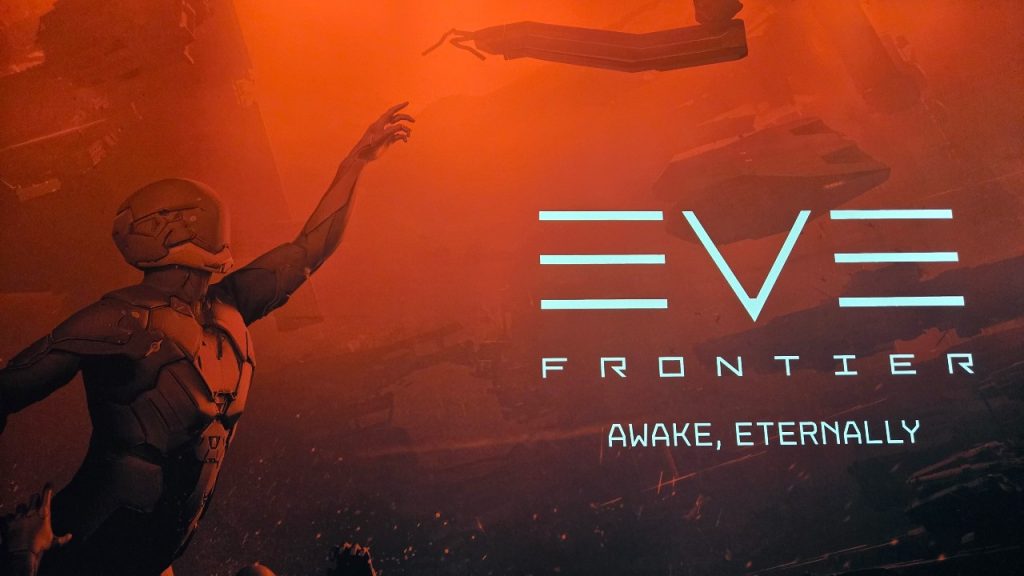
And yet the phrase sits uneasily. For one thing, it doesn’t make obvious sense. It’s not “Live, Eternally” or “Die, Eternally”, or even “Fight, Eternally”; any of which could seemingly work for a game set in the EVE universe.
“Awake, Eternally” seems like a daily task. An ongoing, difficult task.
But it’s this sort of dissonance, and repetitive effort, that points to the sort of experience Hermannsson, Savchuck et al are trying to build.
Its description as a ‘space survival game’ hadn’t chimed with me, partly because I hadn’t played the game enough, but mainly because the game hadn’t previously contained those sort of features.
The launch of Cycle 6 on 25th June will go a long way to change this.
New environmental elements such as heat from being too close to a star or the overwhelming cold of space will now kill you and your ship. The game’s NPC feral AIs have been modified, made smarter, given communication skills, and, as a group, made more deadly. Then there’s the new leech enemy, which will attach to your ship, drain its energy, and then disengage, hiding to create a chrysalis, then spawning into a mini-boss.
There’s even collision damage, another reinforcement of the game’s demand to base itself on real-world physics. This runs as deep as simulating the collision of three black holes with “trippy gravitational lensing” to create the game’s underlying structure of 1 million solar systems. Planets are placed procedurally, with asteroids sprinkled around, based on Lagrange orbits.
It’s all very different compared to EVE Online, which now seems rather cuddly in comparison. There are plenty of ways to die in EVE, of course, but these mainly involve being killed by other players. By contrast, in Frontier, the very fabric of the game is actively trying to kill you.”
“Survival is key. It’s a visceral experience,” explains Savchuck. “You will die and suffer for a reason. It will be a transformative struggle.”
Getting players committed to ‘death as useful information’ will be key, and one key element of this is the way players will save and use their progress.
The game’s fundamental element is Self: your permanent identity, which give players a maximum of 27 slots into which they save their skills. These capabilities can then be copied into crowns, which are slotted into a shell that’s your game character, sitting in your ship.
You will have many shells, each optimized for specific tasks. Deploying them in-game enables you to accumulate experiences that you can save into your Self when you return to base, giving EVE Frontier some of the rhythm of an extraction shooter.
Save often, because your shells are going to be destroyed, over and over again.
In that context, “Awake, Eternally” encapsulates less an aspiration and more a work ethic. That’s where meaning will be found.
This is also reflected in how the ship system works. Unlike EVE Online, in which players build or buy Fenris-designed ship types from a catalogue, you will create your unique ship by building, trading and installing individual components.
It’s another system that will launch in Cycle 6, alongside “much, much more”, including the ability to take manual control over your ship’s weapons.
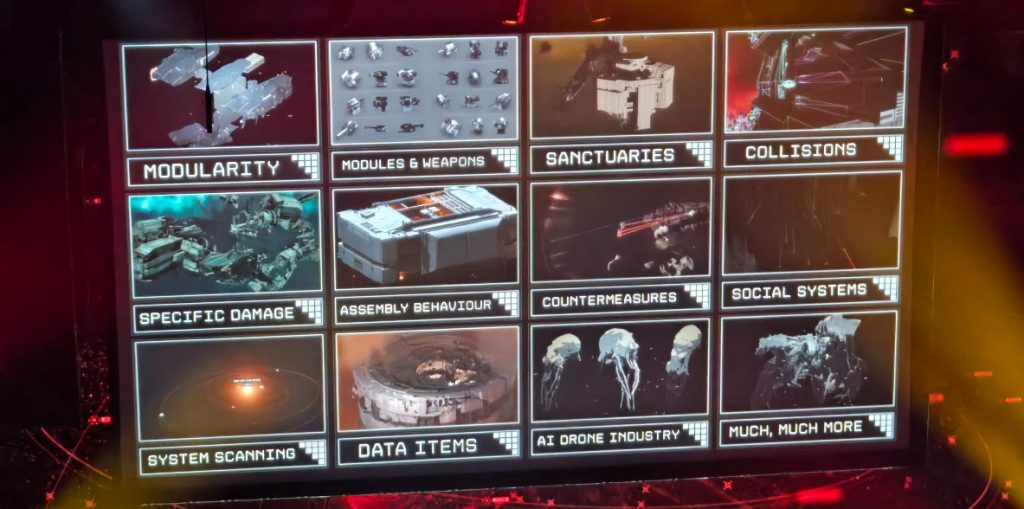
This builds on Cycle 5’s introduction of direct control of your ship’s movement, including support for gamepads. Cycle 6 will complete the feedback loop adding collision damage.
As you’d hope, every new freedom comes with its own set of challenges. And that’s something which feeds into how EVE Frontier integrates blockchain.
At Fanfest, no one from Fenris Creations was eager to talk about blockchain in the speculative sense. When it did come up, it was framed as a unified API: a way to expose the game’s logic, assets and systems so other people can build on top of them. But nor was it ignored. Mysten Labs CEO Kevin Boon joined Hilmar for a fireside chat, while the team behind Sui had a full presence onsite.
That matters because Frontier’s blockchain deployment is not supposed to create meaning by itself. The point is not that an object is onchain and therefore valuable. The point is that, if the world is dangerous enough, persistent enough and socially complex enough, then objects, structures, routes, ships and services can start to accumulate meaning through use.
That is what most blockchain games got backwards. They assumed markets generated meaning. It turned out markets only provided an exit price, not a reason to care. Creating the culture required to sustain long-term value has proved much harder. But EVE Frontier is trying to reverse the order. Build the world first, then let ownership matter.
Enabling anyone to build in its universe is also fundamental to that goal. It’s something underlined by the winner of the recent hackathon, Reality Anchor, who created his CradleOS over eight months by talking to ChatGPT. More bizarrely, he’s never played EVE Online, and only got into EVE Frontier after seeing a Facebook ad.
But this is the perfect encapsulation of the new AI era of gaming for which EVE Frontier is positioned: the classic case of being where the puck is heading.
Or as Hermannsson says, “We are going to build the game. The players will build the rest”.
And, ultimately, this is why EVE Frontier is so ambitious. Not because it is a blockchain game, but because it is building a world hard enough, strange enough and open enough that blockchain might finally have something meaningful to preserve.
Source: https://www.blockchaingamer.biz/features/42282/eve-frontier-visceral-deadly-endless-ambition/